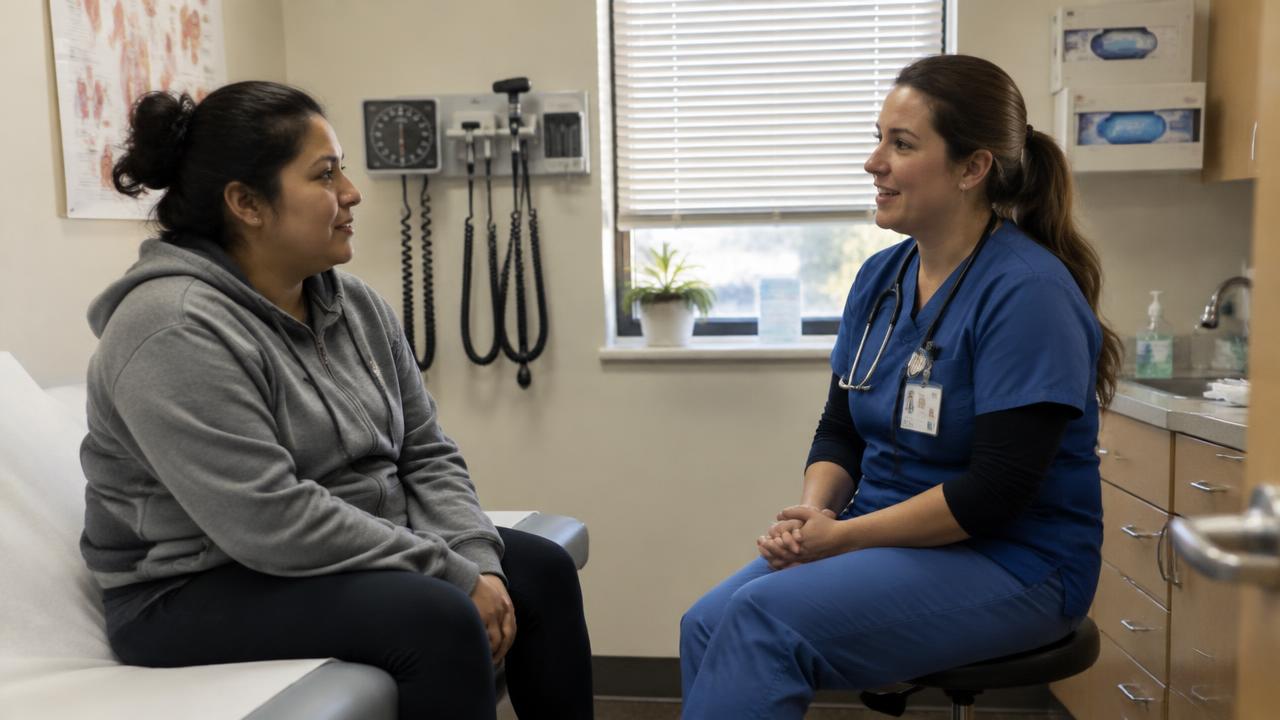
Medical Spanish for Physician Assistants: Why It Matters and How to Learn It
Why physician assistants benefit from medical Spanish, how to choose between self-study, an accredited online CME course, one-to-one tutoring, and clinical immersion in Peru — plus the highest-leverage phrases for PA workflow.
Physician assistants are everywhere Spanish-speaking patients show up: primary care, urgent care, emergency departments, surgical services, hospital medicine, and specialty consults. PAs also tend to carry a high volume of brief, communication-dense encounters — the exact encounters where a language gap does the most damage to rapport, adherence, and the quality of the history.
This guide covers three things: why medical Spanish is worth the effort specifically for PAs, the realistic ways to learn it (with the trade-offs of each), and a starter set of phrases mapped to PA workflow. Throughout, one rule stands: learning Spanish complements professional interpreters, it never replaces them.
Why medical Spanish matters for PAs
Roughly 1 in 5 people in the U.S. speaks Spanish at home, and a large share of those patients have limited English proficiency. Research consistently links language barriers to longer visits, more diagnostic testing, lower adherence, more readmissions, and worse patient-reported experience. PAs are frequently the first — and sometimes only — clinician a patient talks with during a visit, which puts the communication burden squarely on the PA.
- Better histories. Most diagnoses come from the history. Even partial Spanish helps you catch nuance that gets lost through a rushed phone interpreter connection.
- Faster rapport. Greeting a patient in their language changes the tone of the encounter within seconds, especially in urgent care and the ED.
- Safer discharges. Teach-back in Spanish surfaces misunderstandings about medications and return precautions before the patient leaves.
- Career mobility. Spanish-capable PAs are in demand in community health, federally qualified health centers, border and agricultural regions, and pediatrics.
- CME credit. Accredited medical Spanish training counts toward continuing education, so the time invested does double duty.
Do PAs get CME credit for medical Spanish?
Yes, when the activity is accredited. AAFP Prescribed credit is widely accepted for PAs and is generally recognized as equivalent to AMA PRA Category 1 Credit for reporting purposes. Always confirm acceptance with your certifying body and employer before claiming.
Our online Medical Spanish program is AAFP-Prescribed and awards 38.25 credits across 51 modules — 0.75 credits per module, earned as you go rather than in one block. The one-to-one tutoring track is separately accredited (Activity #112676).
The four realistic ways to learn — and who each suits
Most PAs fail at medical Spanish not from lack of motivation but from choosing a format that does not survive a clinical schedule. Here is an honest comparison.
- 1. Free apps and phrase lists. Cheap and easy to start, but general-purpose vocabulary and no clinical structure or accountability. Fine as a supplement, rarely sufficient alone.
- 2. Accredited self-paced online course. Structured clinical arc, native audio, pronunciation practice, and CME credit. Best for busy clinicians who need flexibility. This is what medicalspanishcme.com provides: the Complete Bundle ($390) combines 26 medical modules and 25 grammar modules for 38.25 AAFP credits, for a one-time payment with no subscription.
- 3. One-to-one tutoring. Live speaking practice with a native-speaking instructor who can focus on your specialty and real cases. Best for PAs who can read and understand but freeze when speaking. Available at medicalspanishcme.com/tutoring (10 sessions, 10 CME credits).
- 4. Clinical immersion abroad. The fastest route to conversational fluency, because you use Spanish all day with real patients. Best for PAs with a block of leave who want a step change rather than incremental gains. See https://medical-electives.net/medical-spanish-cme-course/
Clinical immersion in Peru: what it actually involves
Our sister program, Medical Electives Peru, has run AAFP-accredited medical Spanish immersion for clinicians since 2011. It is built for working healthcare professionals rather than backpacking language students, and PAs are one of the largest participant groups.
- Flexible duration from 1 to 4 weeks, with AAFP Prescribed credit scaled to length (up to 32 credits per week).
- Standard track at 4 hours per day, or an intensive track at 7 hours per day for faster progress.
- Small groups matched to your level, focused on history-taking, explanations, and real patient interaction.
- Weekly community health fairs for authentic patient conversations, with the focus on communication rather than clinical responsibility.
- Accommodation included — a private room with a host family in a safe residential area within walking distance of the center, meals provided, with hotel options available.
- Every participant also receives 12 months of access to the online AAFP-accredited Medical Spanish CME program, so progress continues after you fly home.
- Full details: https://medical-electives.net/medical-spanish-cme-course/
A learning path that works around PA shifts
- Weeks 1–2: take the free assessment to find your level, then work through the greeting, history, and exam modules — 10 to 15 minutes a day.
- Weeks 3–8: add one clinical scenario per week and use at least three phrases per shift with real patients. Repetition in context beats study volume.
- Months 3–4: add one-to-one tutoring if speaking is your bottleneck, targeting the encounters you actually run.
- When you have leave available: book a 1–2 week immersion block in Peru to convert vocabulary into fluency, then keep the online access running for the remaining months.
Greeting and setting the agenda
- "Hola, soy el/la asistente médico(a). Voy a verlo(a) hoy." — Hello, I am the physician assistant. I will be seeing you today.
- "¿Cómo prefiere que le llame?" — What would you like me to call you?
- "¿Me puede decir su nombre completo?" — Can you tell me your full name?
- "¿Qué le trae hoy aquí?" — What brings you in today?
- "Voy a hacerle algunas preguntas y luego lo/la examino." — I am going to ask you some questions and then examine you.
- "Si no entiende algo, por favor dígame." — If you do not understand something, please tell me.
Chief complaint and history
- "¿Cuándo empezó el problema?" — When did the problem start?
- "¿Ha pasado antes?" — Has this happened before?
- "¿Qué lo empeora? ¿Qué lo mejora?" — What makes it worse? What makes it better?
- "¿Ha tomado algún medicamento nuevo?" — Have you taken any new medication?
- "¿Tiene alguna alergia a medicamentos?" — Do you have any medication allergies?
- "¿Ha viajado fuera del país recientemente?" — Have you traveled outside the country recently?
- "¿Tiene antecedentes de [condición] en su familia?" — Do you have a family history of [condition]?
Physical exam instructions
- "Voy a escucharle el corazón y los pulmones." — I am going to listen to your heart and lungs.
- "Respire profundo por la boca." — Take a deep breath through your mouth.
- "Abra la boca y saque la lengua." — Open your mouth and stick out your tongue.
- "¿Le duele cuando aprieto aquí?" — Does it hurt when I press here?
- "Mueva los dedos de la mano / del pie." — Move your fingers / toes.
- "Voy a revisarle la presión y el pulso." — I am going to check your blood pressure and pulse.
Explaining the plan and patient education
- "Necesito pedirle unos exámenes de sangre / una radiografía." — I need to order some blood tests / an X-ray.
- "Voy a hablar con el médico / cirujano y regreso." — I am going to speak with the doctor / surgeon and come back.
- "Este medicamento es para [indicación]." — This medication is for [indication].
- "Tómelo / Tómelos [frecuencia] con comida." — Take it / them [frequency] with food.
- "Es importante terminar todo el antibiótico." — It is important to finish all of the antibiotic.
- "Si empeora, regrese a urgencias." — If it gets worse, return to the emergency room.
Closing and follow-up
- "¿Tiene alguna pregunta sobre lo que hablamos?" — Do you have any questions about what we discussed?
- "Repítame: ¿qué va a hacer cuando llegue a casa?" — Repeat back to me: what are you going to do when you get home?
- "Tiene una cita de seguimiento el [fecha]." — You have a follow-up appointment on [date].
- "Aquí está la receta / la orden de los exámenes." — Here is the prescription / the lab order.
- "Cuídese mucho. Fue un gusto atenderle." — Take good care. It was a pleasure to care for you.
When to use an interpreter
These phrases are for brief, low-risk interactions and rapport. For any conversation involving diagnosis, treatment decisions, informed consent, psychiatric evaluation, end-of-life discussion, or a patient with limited health literacy, use a qualified professional interpreter — in person, by video, or by phone. Bilingual staff and family members are not substitutes for a trained interpreter in those situations, and no amount of course study changes that.
Getting started
If you are unsure where your Spanish stands, start with the free Medical Spanish assessment. It takes about 10 minutes and recommends the modules most relevant to PA practice. From there, the Complete Bundle covers the full clinical arc with CME credit, one-to-one tutoring pressure-tests your spoken Spanish, and a Peru immersion block is the accelerator when you can take the time.
Earn CME credits while you learn
Our AAFP-accredited online medical Spanish course awards 38.25 CME credits across 51 modules. Earn 0.75 credits per module, on your schedule.
Get a free Medical Spanish word and phrase each week
One short email. Clinical vocabulary you can use the same day. Unsubscribe any time.